Portable Laser Welding Machine Guide
Why Portable Laser Welding Machines Matter and What This Guide Covers
Portable laser welding machines are no longer niche tools reserved for large factories with deep budgets and specialist teams. They are moving into fabrication shops, repair departments, and custom workshops because they can join metal quickly, cleanly, and with impressive control. At the same time, the broader laser welding machine market is evolving fast, giving buyers more choices in power, automation, and portability than ever before.
That shift matters because welding is often where productivity, finish quality, and labor cost collide. A machine that reduces rework, limits distortion, and shortens finishing time can change the economics of a job more than its purchase price first suggests. Portable laser systems attract attention for exactly that reason. Instead of anchoring the process to a large cell, they bring the beam to the workpiece. For shops handling railings, cabinets, enclosures, kitchen equipment, elevator parts, sheet metal assemblies, and repair work, that flexibility can be genuinely valuable.
Still, the technology deserves a clear-eyed look. Not every laser welding machine is right for every job, and not every workshop benefits equally from a portable format. Material thickness, joint fit-up, operator training, ventilation, safety controls, and service support all influence results. A well-matched machine can feel like a leap forward. A poorly matched one can become an expensive lesson dressed in glossy brochures.
This article is organized as a practical roadmap so readers can move from curiosity to informed evaluation. The outline includes:
- How a laser welding machine works and what components define performance
- What makes a portable laser welding machine different from a fixed system
- Where handheld laser welding fits in real production and repair environments
- How the process compares with TIG, MIG, and larger automated laser setups
- What buyers should assess around safety, operating cost, maintenance, and return on use
Think of this guide as a workshop floor conversation with the noise stripped away. The goal is not to crown a universal winner, because welding rarely works that way. The goal is to help fabricators, small manufacturers, maintenance teams, and technically curious buyers understand when laser welding is a smart step and when another process still makes more sense.
How a Laser Welding Machine Works: Process, Components, and Performance Basics
A laser welding machine joins metal by concentrating a high-energy beam onto a very small area, creating intense localized heat. That focused energy melts the material at the joint, and as the molten pool cools, the pieces fuse together. In modern industrial systems, the most common source is the fiber laser, valued for electrical efficiency, stable beam quality, and compact design. Many handheld and portable machines on the market use fiber laser sources in power ranges such as 1000 W, 1500 W, 2000 W, and 3000 W, though exact suitability depends on material, thickness, and process setup.
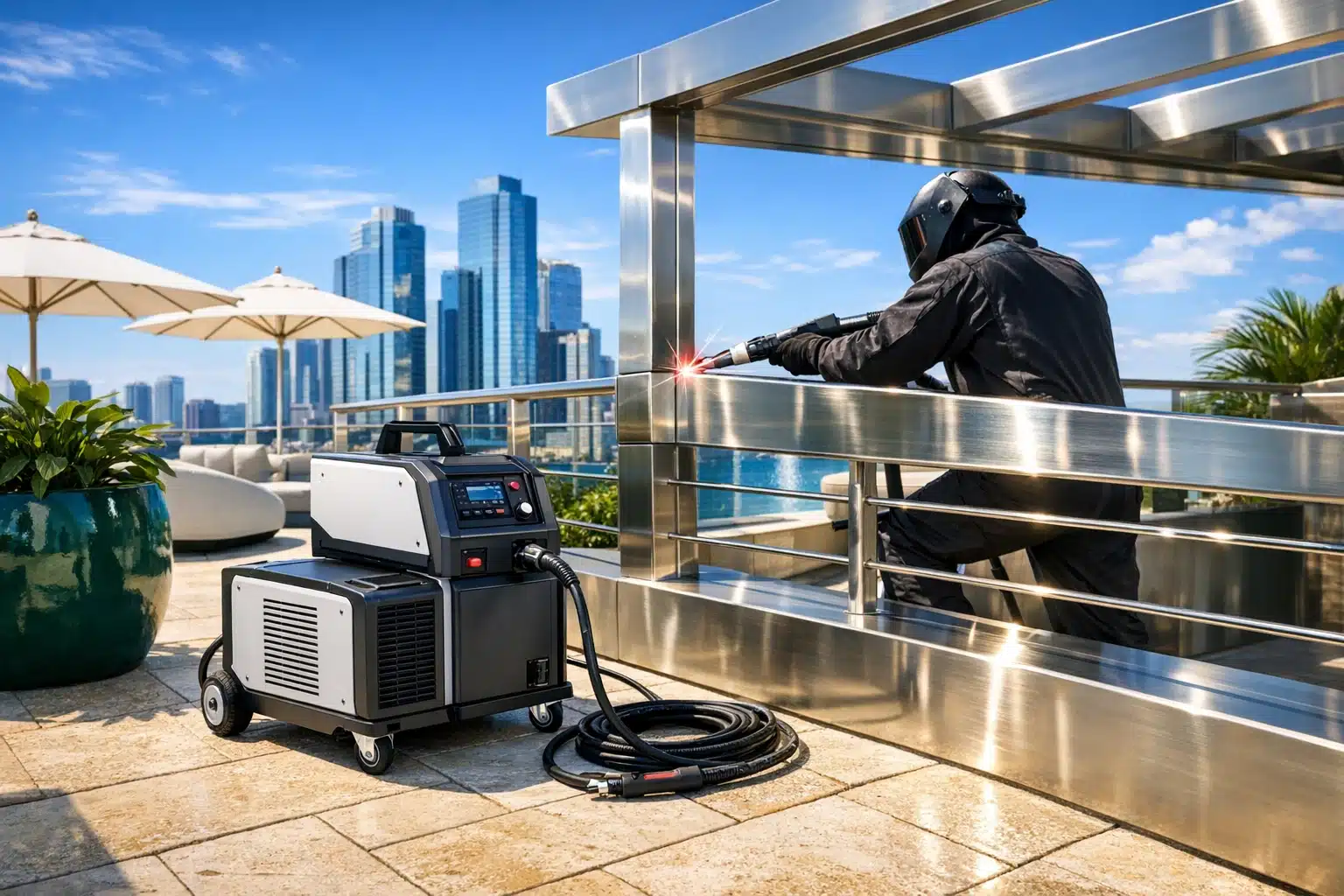
The basic architecture is straightforward, even if the physics is sophisticated. A typical portable laser welding machine includes:
- A laser source that generates the beam
- A fiber cable or beam delivery system
- A handheld welding head or gun with controls
- A chiller to manage operating temperature
- A shielding gas supply, often argon or nitrogen
- Optional wire feeding equipment for gap filling or specific joint needs
At the weld point, the beam can operate in different modes. In conduction welding, heat spreads more gently across the surface, making it useful for thinner materials and cosmetic seams. In keyhole welding, the energy density is high enough to form a narrow vapor cavity, allowing deeper penetration. This is one reason laser welds can be narrow yet strong. Compared with arc processes, the heat-affected zone is often smaller, which may reduce distortion and discoloration when the job is properly tuned.
Beam control is one of the process’s biggest advantages. Spot size, travel speed, pulse or continuous-wave behavior, shielding gas flow, focal position, and wobble settings can all shape the final result. Some handheld systems use oscillating or wobble weld heads to widen the seam slightly, improve tolerance to fit-up variation, and make operation more forgiving. That matters in real shops, because parts rarely arrive as perfectly as software models suggest.
Material choice also affects results. Laser welding commonly works with stainless steel, carbon steel, aluminum, and certain copper alloys, but reflectivity, thermal conductivity, and surface condition all matter. Aluminum and copper, for example, may require more careful tuning than mild steel. Joint preparation matters too. Laser welding generally prefers cleaner surfaces and tighter fit-up than MIG, because the process is precise rather than forgiving by default.
In practical terms, a laser welding machine is not magic. It is a focused, high-speed heat source paired with precise beam delivery. When the machine settings, joint design, and operator technique align, the result can be striking: clean seams, less spatter, reduced post-processing, and faster throughput on suitable parts. When they do not align, the process quickly exposes every shortcut taken before the trigger was pulled.
Portable Laser Welding Machines in Real Work: Advantages, Limits, and Common Applications
The appeal of a portable laser welding machine begins with mobility, but mobility alone is not the full story. What shops are really buying is a combination of access, finish quality, and faster cycle time on appropriate work. A handheld unit can be rolled to a large assembly, positioned near a repair area, or used at a bench without redesigning the entire workspace around a fixed welding cell. For many small and mid-sized operations, that flexibility is easier to justify than a fully automated laser installation.
One major advantage is speed. Depending on the material, joint type, and operator experience, handheld laser welding can outpace TIG by a meaningful margin. It may also produce less spatter than MIG and reduce grinding or polishing afterward. That last part matters more than it first appears. On decorative stainless assemblies, visible seams often consume labor not during welding itself, but during finishing. If a portable laser system produces a neater bead and a smaller heat tint area, the saving often shows up in downstream labor rather than in arc time alone.
Common use cases include:
- Stainless steel furniture, cabinets, and food-service equipment
- Architectural metalwork such as rails, trims, and frames
- HVAC ducting, housings, and light sheet metal assemblies
- Tooling repairs and maintenance welding in industrial plants
- Battery enclosures, electrical boxes, and precision brackets
- Small-batch fabrication where part variety is high
Portable systems are especially attractive where part sizes are awkward. Imagine a large stainless enclosure that is easy to damage during repeated repositioning. Bringing the welder to the part, rather than forcing the part through a crowded process chain, can be a practical win. In that sense, the machine behaves a bit like a skilled craftsperson carrying precision in one hand and efficiency in the other.
Yet limitations deserve equal attention. Portable laser welding machines usually prefer tighter joint gaps than MIG and often demand cleaner edge preparation. If the shop regularly deals with rusty steel, inconsistent fit-up, or heavy structural members welded outdoors in changing conditions, traditional processes may remain more dependable. Handheld lasers also require disciplined safety practices because the beam energy is concentrated and reflection risk must be controlled.
Thickness range is another reality check. Many portable machines are strongest on thin to medium-gauge metals rather than very heavy sections. Some manufacturers market broad thickness capability, but actual results depend on joint design, metallurgy, wire use, penetration requirements, and code compliance needs. In short, portable laser welding excels where cleanliness, speed, appearance, and manageable thickness come together. It is a strong specialist, not an automatic replacement for every welding task under a workshop roof.
Laser Welding Machine vs TIG, MIG, and Stationary Systems: A Practical Comparison
Comparisons matter because buyers rarely choose a laser welding machine in isolation. They choose it against something they already know: TIG, MIG, resistance welding, or a larger fixed laser system. Each process has a personality. TIG is patient and precise, MIG is productive and forgiving, and laser welding is focused, fast, and highly sensitive to setup quality. Understanding those personalities is more useful than chasing a single headline number.
Compared with TIG welding, a portable laser welding machine often offers higher travel speed and less post-weld finishing on suitable materials, especially stainless steel sheet and thin assemblies. TIG remains strong where visual control, delicate manual input, and fine heat management are important. It also tends to be better understood in many shops, which lowers the training barrier. Laser welding can shorten the learning curve for producing neat seams, but that does not eliminate the need to understand joint behavior, shielding gas, focal position, and safety requirements.
Against MIG, laser welding usually creates a narrower weld, less spatter, and a smaller heat-affected zone. That can translate into lower distortion and less cleanup. MIG, however, is often more tolerant of imperfect fit-up, wider gaps, and rougher shop conditions. It also remains a practical choice for thicker structural fabrication, field work, and jobs where rugged output matters more than refined finish. Put simply, MIG is the pickup truck of many metal shops; laser is the high-precision van that shines when the route is paved and the cargo matters.
Compared with stationary industrial laser systems, portable machines trade automation potential for flexibility. A fixed laser cell may include vision systems, robotics, enclosures, and repeatable part handling for high-volume production. That environment supports consistency and throughput on repetitive parts, but it requires floor space, capital, fixtures, and production stability. Portable units make more sense when:
- Part geometry changes frequently
- Production volume is low to medium
- Assemblies are too large or awkward to move often
- A shop needs one machine to serve multiple work areas
- Investment must be phased rather than made all at once
There are also business-level tradeoffs. A portable system may reduce rework, finishing time, and operator fatigue on some jobs, but it can introduce new expenses in training, shielding gas, consumables, service contracts, and safety controls. Meanwhile, a fixed automated cell may offer stronger long-term economics only if throughput is high enough to justify the infrastructure around it.
The most honest conclusion is that these technologies often complement one another. Shops that handle mixed work may keep TIG for finesse, MIG for heavy or gap-prone jobs, and a portable laser welding machine for speed, cosmetic quality, and flexible production. The smartest comparison, then, is not which process is universally better. It is which process solves the most valuable problems in your actual workflow.
Buying Guide, Safety Essentials, Operating Costs, and Final Advice for Target Users
Choosing a portable laser welding machine should begin with parts, not brochures. Start by reviewing the metals you weld most often, their thickness range, joint types, production volume, finish requirements, and tolerance for rework. A shop making stainless counters and decorative frames may value seam appearance and low distortion above all else. A maintenance team may care more about quick setup and mobility across departments. A contract manufacturer might focus on throughput, repeatability, and how fast operators can switch between job types.
Power class is one of the first decisions. Machines in the 1000 W to 1500 W range are often considered for thinner materials and lighter fabrication, while 2000 W or higher may support broader application ranges. But power alone does not tell the whole story. Beam quality, wobble function, wire feeder performance, control interface, cooling stability, and supplier support are just as important. A slightly smaller machine from a reliable vendor can be a better business decision than a more powerful unit with weak service access.
When evaluating total cost, consider more than the purchase price:
- Protective eyewear and wavelength-specific safety gear
- Fume extraction or ventilation upgrades
- Shielding gas consumption
- Nozzles, lenses, and other wear parts
- Operator training and procedure development
- Downtime risk and local service response
Safety deserves special emphasis. Most laser welding systems used in fabrication are Class 4 devices, meaning they can cause serious eye and skin injury if misused. Reflections from metal surfaces are a real concern, particularly on polished materials. Safe use may require controlled work areas, beam-safe curtains or enclosures where appropriate, warning signage, interlocks in some environments, and consistent personal protective equipment. A shop that treats laser welding like a casual upgrade to arc welding is taking the wrong first step.
Maintenance is usually manageable but not optional. Keep optics clean, inspect nozzles, verify chiller performance, protect the machine from dust buildup, and follow the manufacturer’s service schedule. Portable units live closer to real shop traffic, which means cables, connectors, and handheld heads may experience more physical wear than fixed systems. Preventive attention is cheaper than interrupted production.
Conclusion for Fabricators, Repair Teams, and Industrial Buyers
If your work involves thin to medium-gauge metals, visible seams, mixed production, or large parts that are inconvenient to move, a portable laser welding machine may offer real operational value. It can improve speed, reduce cleanup, and open up a more flexible workflow when the parts and team are well matched to the process. If your jobs routinely involve poor fit-up, heavy structural sections, or harsh field conditions, conventional methods may still be the more practical foundation. For most buyers, the right decision is not about chasing the newest tool, but about choosing the welding process that fits the work, the people, and the pace of the business.