How Kindergarten Works in Switzerland
For a small child, Swiss kindergarten can feel like the doorway to a bigger world: coat hooks, circle time, forest walks, and the first friendships made without a parent nearby. Behind that gentle scene sits a carefully structured public system with rules on entry age, attendance, support, and progression. It blends play, routine, and autonomy more than many families expect. Knowing how it works makes school choices, daily logistics, and emotional preparation far easier.
Article Outline
- The place of kindergarten within the Swiss school system
- Enrollment, schedules, costs, and everyday organization
- What children learn and how learning is assessed
- The role of teachers, parents, and support services
- Regional differences, common challenges, and practical advice for families
1. Where Kindergarten Fits in the Swiss Education System
Kindergarten in Switzerland sits at an interesting crossroads between early childhood care and formal schooling. To many outsiders, the word suggests an optional pre-school year built around songs, toys, and nap time. In Switzerland, the picture is more structured. Across much of the country, children attend two years of kindergarten, usually beginning around the age of four, and these years are closely linked to compulsory education. The exact legal framing depends on the canton, because Swiss education is decentralized, but the broad national pattern is clear: kindergarten is not treated as a casual extra. It is the first rung of the school ladder.
This structure reflects a core feature of Swiss public life. Cantons hold major responsibility for education, while municipalities often handle local school administration. That means parents will see a shared philosophy across the country, yet they may also encounter different rules on age cutoffs, attendance requirements, lesson schedules, and support services. A family moving from Zurich to Vaud, or from Basel to Ticino, may find that the rhythm of the school week changes even though the underlying purpose of kindergarten remains similar.
Compared with systems in some English-speaking countries, Swiss kindergarten usually places less emphasis on early academic acceleration and more emphasis on readiness for school life. Children learn how to take turns, follow routines, listen in a group, move safely through public space, and manage simple tasks alone. In that sense, kindergarten works like a bridge. It helps children cross from the private world of home or nursery into the shared world of public institutions.
Terminology also varies by language region. In German-speaking areas, the term “Kindergarten” remains standard. In French-speaking cantons, families may hear “école enfantine” or see the first years integrated into a broader primary cycle. In Italian-speaking Ticino, different local terms and structures may appear. These labels matter less than the common goal: giving children a stable entry into communal learning.
A useful way to understand the Swiss model is to compare it with a well-built train network. The stations may look slightly different from canton to canton, but the route is designed to move children steadily forward. Kindergarten is the first station, not a waiting room. That is why parents are asked to take attendance, punctuality, and preparation seriously from the beginning.
- Most children attend two years of kindergarten.
- Rules are shaped by cantonal law and local administration.
- The focus is broad development rather than early formal testing.
- Kindergarten is commonly linked to the compulsory school pathway.
2. Enrollment, Daily Schedule, and the Practical Side of Attendance
Once parents understand that kindergarten is part of the educational system rather than a loose childcare option, the next question is practical: how does a child actually get in, and what does the week look like? In Switzerland, enrollment is usually handled through the municipality or local school authority. Families often receive official information automatically when a child reaches the relevant age, although this process can differ depending on where they live. Parents who are new to the country should not wait passively if they are unsure. Contacting the local commune or school office early is one of the simplest and smartest steps they can take.
Public kindergarten is generally tuition-free, which is an important distinction from many private nurseries or daycare centers. However, “free” does not always mean costless in the wider sense. Depending on the municipality, families may still pay for lunch supervision, after-school care, transportation in special cases, or optional activities. In urban areas where both parents work full-time, these surrounding services can matter as much as the classroom itself.
The daily schedule often surprises international families. Swiss kindergarten commonly runs in half-day blocks rather than as one long continuous day. Many children attend in the morning on most weekdays and return for selected afternoons, though this pattern varies by canton, municipality, and year level. Wednesday afternoons are frequently free in school culture, especially for younger children, although local exceptions exist. For parents used to a 9-to-5 school structure, Swiss timetables can feel like a jigsaw puzzle spread across the kitchen table.
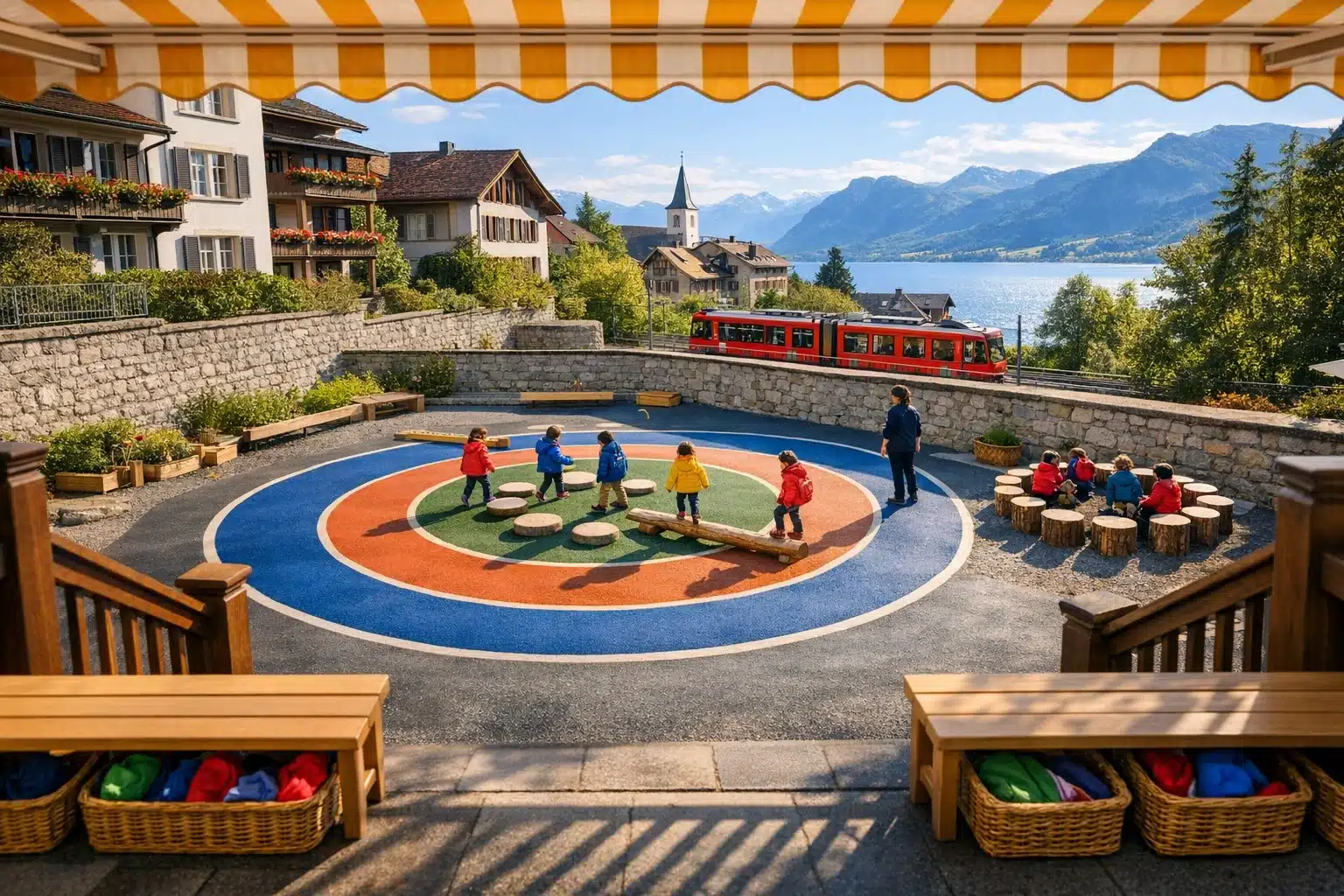
Another practical feature is the expectation of growing independence. Children are often expected to walk short distances, hang up their own coats, change shoes, carry a small backpack, and manage basic toileting without constant adult help. Teachers support them, of course, but Swiss kindergarten gently trains self-management from the first weeks. Weather also plays a real role. Outdoor play is normal in rain, cold, and changing seasons, so sturdy shoes and layers are not optional extras; they are part of the school toolkit.
Parents often need to prepare for everyday details such as:
- registration deadlines and proof of residence
- birth-date cutoff rules in the local canton
- indoor shoes, spare clothes, and weatherproof outerwear
- snack guidelines and lunch arrangements
- after-school care options if the timetable is fragmented
Private kindergartens also exist, especially in larger cities and international communities. They may offer bilingual teaching, longer hours, or alternative pedagogies such as Montessori. Even so, the public system remains the reference point for most families. It is local, structured, and closely connected to the next stage of schooling. Understanding its timetable early helps parents avoid stress later, especially when transport, work hours, and childcare all have to click into place like gears in a watch.
3. What Children Learn in Swiss Kindergarten
If a parent peeks into a Swiss kindergarten classroom, the first impression may look delightfully ordinary: children drawing, building, singing, listening to stories, dressing dolls, cutting paper, or heading outdoors in bright jackets. Yet beneath that lively surface lies a clear educational purpose. Swiss kindergarten is intentionally play-based, but “play-based” should never be confused with aimless. Children are learning how to function in a group, how to express needs, how to observe patterns, how to move with confidence, and how to build the habits that later academic learning depends on.
One major area of development is language. This includes listening, speaking, storytelling, vocabulary growth, and understanding instructions. In multilingual Switzerland, language can be especially important. A child in German-speaking Switzerland may hear Swiss German in everyday classroom interaction while also becoming familiar with Standard German, especially through books, songs, and later literacy preparation. In French-speaking and Italian-speaking regions, the same principle applies in local forms: the school environment becomes a place where children learn not only words, but the social use of language.
Motor development also receives serious attention. Fine motor skills are strengthened through cutting, drawing, threading, painting, and crafting. Gross motor skills grow through movement games, playground time, climbing, balancing, and outdoor exploration. In some schools, regular time in nature is central. Forest-based activities are more than a charming Swiss stereotype. They help children develop stamina, coordination, risk awareness, and curiosity. Mud on boots is often a sign of participation, not disorder.
Early mathematical and pre-literacy skills appear in gentle, age-appropriate ways. Children sort objects, notice sequences, compare sizes, count items, hear rhymes, recognize sounds, and begin to understand symbols and structure. In many classrooms, formal reading and writing instruction is limited compared with systems that push academics earlier. Switzerland tends to value readiness over speed. The logic is simple: a child who can listen, focus, cooperate, and manage frustration has a stronger foundation than a child who has merely memorized a few letters ahead of schedule.
Assessment in kindergarten is usually descriptive rather than exam-driven. Teachers observe social behavior, language development, attention, motor coordination, and classroom participation. Parents may receive reports or attend meetings where strengths and areas for support are discussed. This approach can feel refreshingly human. Instead of treating the child like a tiny applicant in a race, the system tries to see the whole person.
- Social learning is central, not secondary.
- Language growth is especially important in multilingual contexts.
- Movement, crafts, music, and outdoor time are core elements.
- Formal academics are introduced gradually and with restraint.
That balance is one reason Swiss kindergarten often earns praise. It takes childhood seriously without turning it into a performance.
4. Teachers, Parents, and the Support Network Around the Child
A kindergarten does not work through curriculum alone. It works because adults around the child form a network that is structured, observant, and generally clear about responsibilities. In Switzerland, kindergarten teachers are trained education professionals, usually prepared through specialized tertiary-level teacher education institutions. Their role is broader than supervising activities. They watch how children enter the room, how they separate from parents, how they react to frustration, how they play with others, and how they respond to routines over time. A good teacher in this setting is part educator, part guide, and part careful reader of small signals.
Communication between school and home tends to be practical and purposeful. Parents may receive letters, schedules, invitations to meetings, and information about projects, excursions, holidays, or health rules. In many schools, there are parent evenings that explain expectations before or shortly after the school year starts. This is especially valuable for newcomers, because Swiss schools often assume that families will respect timing, attendance, and administrative procedures quite strictly. A missed note about sports clothes or an excursion day can create unnecessary tension, not because the school is severe, but because routine is considered part of educational life.
Support services are another important piece of the system. If a child shows signs of language delay, motor difficulty, social challenges, or developmental differences, schools may work with specialists such as speech therapists, psychologists, special education teachers, or support staff. The availability and exact pathway vary by canton, yet the principle is widely recognized: early observation matters. Families do not need to panic if a teacher raises a concern. In many cases, this simply opens the door to support at a stage when help can be especially effective.
For international families, one recurring challenge is language. A child may enter kindergarten with little or no familiarity with the local school language. Teachers are often used to this reality, particularly in cities with diverse populations, but the experience can still feel intense for both child and parent. What helps most is not a frantic attempt to reproduce school at home. It is steady exposure, calm encouragement, storytelling, songs, and time. Children often absorb far more than adults expect once the environment becomes familiar.
Parents can support the transition by focusing on everyday readiness:
- practice putting on shoes and jackets independently
- encourage listening to simple instructions
- build confidence in using the toilet alone
- create regular sleep and morning routines
- stay in contact with the teacher when questions arise
When this partnership works well, kindergarten becomes more than a place children go. It becomes a shared project, one that teaches families how Swiss schooling functions from the ground up.
5. Regional Differences, Common Challenges, and Practical Takeaways for Families
No explanation of Swiss kindergarten is complete without one final reminder: Switzerland is deeply local. The country may be famous for precision, yet its education system is not a single machine built in one workshop. It is a federation of parts that usually move in the same direction, though not always at the same speed or in exactly the same shape. That is why one family may describe kindergarten as mostly morning-based and highly flexible, while another describes firm afternoon attendance and a more structured weekly pattern. Both accounts can be true.
Regional differences appear in several areas. Entry dates can vary. The balance between kindergarten and the first years of primary school may be organized differently. Childcare around school hours can be extensive in some municipalities and limited in others. Urban cantons often offer more supplementary services, while rural communities may expect children to adapt to simpler local arrangements. Language also changes the lived experience. In German-speaking areas, Swiss German can feel like a second doorway inside the first doorway, especially for foreign families who learned Standard German abroad. In French-speaking or Italian-speaking cantons, the social and administrative rhythm may feel different again.
Several challenges come up repeatedly for parents. One is timetable fragmentation, especially for working households. Another is the emotional shock of the first separation if a child has spent little time in group care. A third is clothing and outdoor readiness; Swiss schools do not stop being Swiss when the weather becomes damp, cold, or muddy. There is also the simple cultural adjustment of realizing that independence is expected early. A child may be very lovingly supported, yet still be asked to manage small tasks alone.
For parents preparing the transition, a few steps make an outsized difference:
- contact the local school authority early and ask about deadlines
- confirm the weekly timetable, including lunch and afternoon care
- label clothes, shoes, and bags clearly
- practice short routines at home rather than formal academics
- ask about language support if your child is new to the school language
- treat teacher communication as essential, not optional paperwork
For the target audience of this topic, especially parents, relocating families, and caregivers comparing systems, the main takeaway is reassuring. Swiss kindergarten is structured, but it is not cold. It values independence, but it does not abandon children to figure everything out alone. Its real aim is to help young learners settle into community life, school habits, and confident daily participation. Once families understand the local rules and the broader philosophy behind them, the system becomes far less mysterious. The first day may still come with a tight throat and a brave little wave at the door, but after that, the rhythm usually begins to make sense.