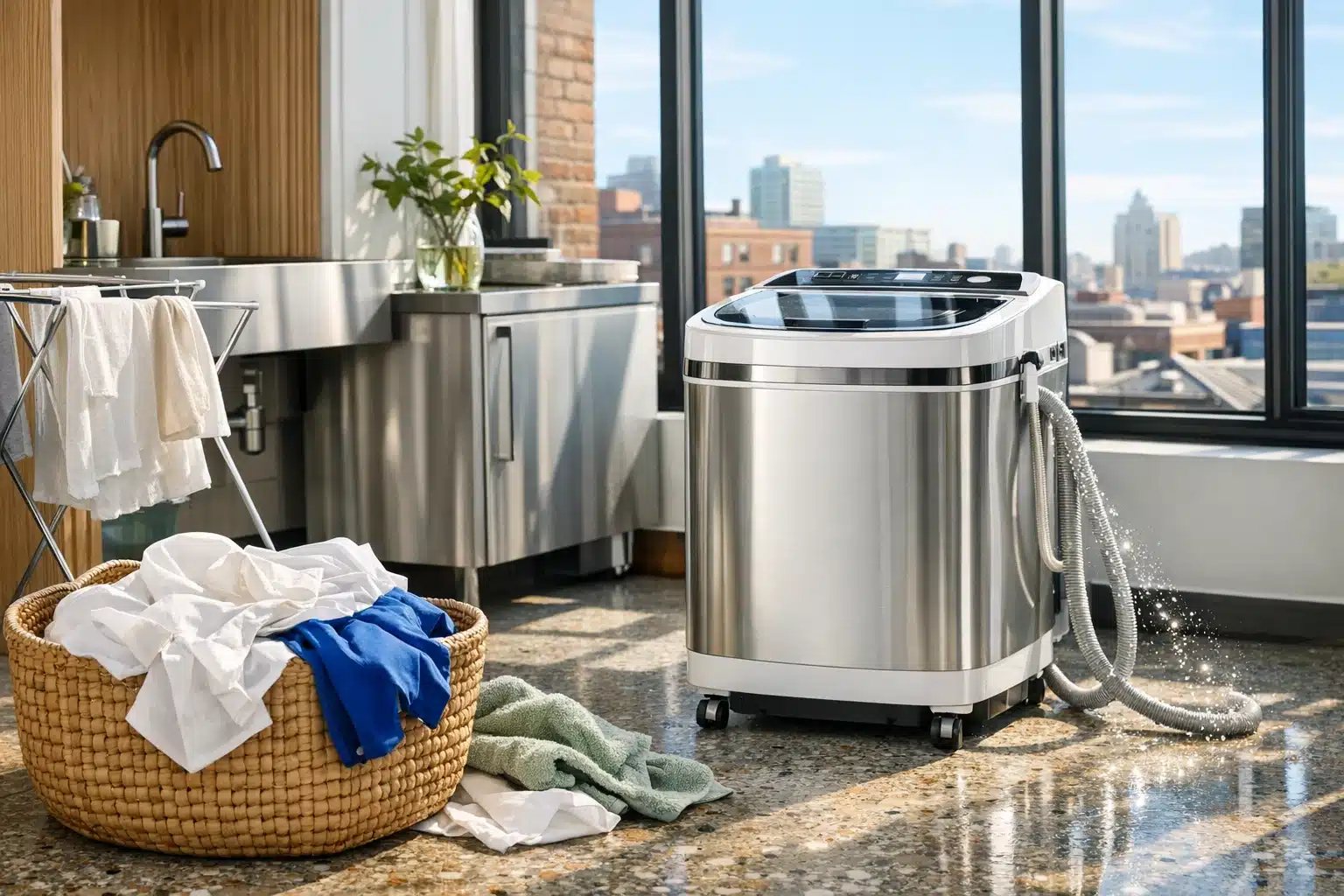
 Artificially generated image
 Portable Washing Machine Guide: Features, Benefits, and Buying Tips
Portable washing machines have moved from niche dorm-room gadgets to practical laundry tools for renters, RV travelers, small-home owners, and anyone tired of hauling baskets to a shared laundry room. They save space, reduce dependence on laundromats, and make weekly chores easier when square footage is limited. This guide explains how these compact machines work, where they fit best, and what to consider before bringing one home.
Article Outline
This article covers five main areas: what a portable washing machine is and who it suits, the main types and features available, the benefits and limitations compared with other laundry options, the key factors to compare before buying, and the best practices for setup, daily use, and maintenance.
1. What a Portable Washing Machine Is and Why It Matters
A portable washing machine is a compact laundry appliance designed for homes and living situations where a standard washer is impractical. Unlike a full-size unit that usually needs a dedicated water line, drain, and permanent location, a portable model is built for flexibility. Many are small enough to roll out of a closet, connect temporarily to a sink, and store away after use. Others are light enough to lift into place when needed. That convenience is exactly why these machines appeal to people living in apartments, student housing, boats, RVs, guest suites, and small homes.
The importance of portable washing machines is tied to changing lifestyles. Urban living often means higher rent and less space. In many buildings, laundry rooms are shared, coin-operated, or located on another floor. That may not sound dramatic until you are carrying a heavy hamper down three flights of stairs on a rainy evening. A portable washer can turn that tiring routine into an at-home task that fits around your schedule. For parents washing baby clothes, workers needing clean uniforms, or travelers staying long-term in one spot, that added control can be genuinely valuable.
Portable models generally fall into two broad categories: fully automatic machines and semi-automatic or twin-tub machines. Fully automatic versions handle washing and spinning in a way that feels more familiar to users of standard household washers. Semi-automatic machines often require more hands-on effort, such as moving clothes from one tub to another, but they can be more affordable and water-efficient in certain situations. Some extremely compact non-electric units also exist, though they are better viewed as specialty solutions than everyday appliances.
These machines matter because they offer a middle path between hand washing and buying a full-size washer. They are especially useful for:
- Renters who cannot install permanent appliances
- People who want to avoid frequent laundromat costs
- Households with limited space but regular laundry needs
- RV or vacation property owners who need flexible washing options
That said, portable washers are not magic boxes that erase all laundry frustrations. Their capacity is smaller, heavy bedding may be unrealistic, and setup can be less seamless than a built-in machine. Still, for the right user, they can feel like a quiet revolution in a very ordinary corner of life. A machine that fits beside a sink may not sound glamorous, but on a busy weeknight, it can feel wonderfully smart.
2. Types, Features, and How Portable Models Differ
Shopping for a portable washing machine becomes much easier once you understand the major design categories and feature differences. Not every compact washer serves the same purpose, and the wrong choice can feel limiting very quickly. The main divide is between fully automatic, semi-automatic, and manual models. Each comes with a different balance of convenience, cost, washing capacity, and mobility.
Fully automatic portable washers are the most familiar and beginner-friendly. They typically have one drum, multiple wash programs, a built-in pump on many models, and a spin cycle that removes a good amount of water before air drying. These machines are ideal for users who want a “load it, select a cycle, and wait” experience. Many connect to a standard faucet with an adapter, then drain into a sink or tub. Capacity often ranges from around 0.9 to 2.0 cubic feet, which is enough for small to moderate laundry loads such as shirts, undergarments, towels, and children’s clothing.
Semi-automatic machines usually come in twin-tub designs. One side washes and the other spins. They often cost less than fully automatic models and may allow greater user control over water use and cycle timing. However, they also require you to move clothes between compartments. Some people appreciate that simplicity, especially if they want a machine with fewer electronic parts. Others find the extra handling inconvenient, particularly for routine family laundry.
Manual portable washers occupy a smaller niche. They may use hand cranks, foot power, or compressed motion rather than electricity. These are usually best for camping, emergency use, or occasional washing of very small loads. They are rarely the best choice for households that need consistent weekly laundry support.
Important features can make a noticeable difference in daily use. Look closely at:
- Capacity, often listed by pounds or cubic feet
- Built-in pump versus gravity drain
- Wash programs for delicates, normal clothing, or quick loads
- Spin speed and effectiveness
- Noise level, especially for apartment living
- Caster wheels, handles, or compact dimensions for storage
- Water level settings and energy usage
Material quality also matters. Stainless steel tubs generally resist wear better than plastic interiors, though both are common in the category. Hose quality, connector fit, and lid durability deserve attention too, because portable washers are moved and connected more often than permanent machines. In short, the details are not minor. On a portable machine, they shape the entire ownership experience.
3. Benefits and Limitations Compared with Full-Size Washers and Laundromats
The strongest argument for a portable washing machine is convenience with realistic boundaries. It will not replace a large-capacity laundry room for every household, but it can outperform laundromat trips and hand washing by a wide margin. To understand its value, it helps to compare portable models with both full-size home washers and external laundry options.
Compared with a standard washer, the most obvious advantage is size. Portable units can fit into kitchens, bathrooms, utility corners, studio apartments, and temporary living spaces where a permanent machine would be impossible. They also usually use less water and electricity per load, although overall efficiency depends on model type and how often you run small loads. For one person or a couple, this can be a sensible trade-off. Instead of waiting for one giant weekend wash day, you can clean essentials throughout the week.
Cost can also favor portable machines over time. Laundromat visits seem manageable until you total them across months. If a wash-and-dry cycle costs several dollars per load and you do multiple loads each week, the yearly cost adds up quickly. A portable washer will not eliminate all expense, especially since clothes still need air drying or a compatible dryer solution, but it may reduce recurring laundry bills substantially.
There are also lifestyle benefits that are hard to measure in a spreadsheet. You can wash workout gear the same day, clean baby items when needed, or deal with a coffee spill before it sets. That kind of flexibility makes routine care easier and can extend the life of clothing. In shared buildings, it also means less waiting, fewer hygiene concerns around public machines, and no need to keep pockets full of coins or apps open for machine payments.
Still, limitations matter just as much as benefits:
- Capacity is smaller, so large bedding and heavy blankets may not fit well
- Spin cycles often leave more moisture than full-size machines
- Setup and draining require more user involvement
- Some landlords or lease terms may restrict appliance use
- Noise and vibration can be noticeable on weak flooring
Compared with laundromats, portable washers offer privacy and scheduling freedom. Compared with standard washers, they offer flexibility and lower space demands. The compromise is throughput. If your household generates piles of towels, jeans, bedding, and school uniforms every week, a compact model may feel stretched. But if your laundry needs are moderate and your space is tight, a portable washer can occupy a sweet spot that feels surprisingly efficient.
4. How to Choose the Right Portable Washing Machine
Choosing the right portable washing machine starts with honesty about your space, your laundry habits, and your tolerance for hands-on setup. Many buyers make the mistake of focusing only on dimensions or price, then discover that the machine does not suit their clothing volume, faucet style, or drainage options. A better approach is to evaluate the machine as part of a system: where it will sit, how it will fill, where it will drain, how often it will run, and what kinds of garments it needs to handle.
Capacity should be one of your first checkpoints. A very compact machine may work beautifully for one person washing light clothing, socks, sleepwear, and gym clothes. A couple or small family may need a larger drum to avoid running too many loads. Manufacturers often list capacity in pounds, but that number can be misleading if you imagine dry fabric weight only. Bulky items take up space fast, even when they are not especially heavy. Reading user manuals and customer reviews can give you a more realistic sense of what fits comfortably.
Connection style is another major factor. Some portable washers attach to kitchen or bathroom faucets using an included adapter. Others need manual filling or are better suited to utility sinks. Drainage matters just as much. A model with a drain pump can move water upward into a sink more reliably, while gravity-drain models usually need the hose positioned lower than the drum. This one detail alone can determine whether the machine is effortless or frustrating.
Before buying, compare these practical points:
- Available floor space and storage space
- Doorway width and ease of moving the machine
- Water source compatibility and included adapters
- Drain hose length and pump presence
- Cycle options, timer controls, and spin performance
- Energy use, warranty terms, and replacement part availability
- Noise output if neighbors or roommates are close by
Budget is important, but cheapest is not always wisest. A lower-priced machine with weak hoses, poor spin performance, or unreliable controls may cost more in inconvenience than it saves up front. Mid-range models often provide a better balance of durability and convenience. If you plan to use the machine several times a week, build quality is worth paying for.
Finally, think about your daily rhythm. A machine that asks for extra steps may be perfectly fine if you value lower cost and control. If you want laundry to happen in the background while you cook dinner or answer emails, a fully automatic unit will likely feel more satisfying. The best portable washer is not the one with the longest feature list. It is the one that fits your life without becoming another chore.
5. Setup, Use, Maintenance, and Long-Term Ownership Tips
A portable washing machine can work well for years if it is set up carefully and used with a little consistency. Because these appliances are moved more often than standard washers and frequently connect to temporary water sources, proper handling matters more than many new owners expect. The good news is that daily care is simple once the routine becomes familiar.
Start with placement. Put the machine on a flat, stable surface that can tolerate a little moisture. Uneven floors increase vibration and can make spinning noisy or less effective. If your model has wheels, lock them before starting a cycle. When connecting to a faucet, check that the adapter fits securely and that the hose is not twisted. During draining, make sure the hose is properly positioned so water flows as intended. A small oversight here can lead to leaks, splashing, or poor drainage performance.
Loading habits also affect results. Portable washers do best when clothes can move freely. Overloading reduces wash quality, strains the motor, and can make spinning unbalanced. Use detergent sparingly, especially high-efficiency detergent if the manufacturer recommends it. Too much soap can leave residue and increase rinse time. For delicate garments, mesh laundry bags can help reduce tangling. For heavier fabrics such as jeans or hoodies, balance the load rather than piling everything on one side.
Routine maintenance is not complicated, but it should not be ignored:
- Wipe the drum and lid after use to reduce moisture buildup
- Leave the lid open for a while so the interior can dry
- Clean the lint filter if your model includes one
- Inspect hoses and connectors for wear or looseness
- Run a cleaning cycle or tub-clean process periodically
- Check for trapped debris near the drain pump or outlet
Long-term ownership is often shaped by small habits. If you store the machine between uses, drain it fully first. In cold environments, leftover water can create problems. If you move homes often, keep the original manual and fittings together in a labeled bag. Replacement faucet adapters are not always easy to match later. If you notice unusual noise, burnt smells, or weak spinning, stop using the machine until you identify the issue. Early attention usually prevents bigger repairs.
There is something quietly satisfying about mastering a compact washer. It turns laundry from a trip into a rhythm, from a public errand into a private task done on your own terms. That is the real long-term benefit: not just cleaner clothes, but a smoother routine built around the space you actually have.
Conclusion for Renters, Small-Space Households, and Practical Buyers
Portable washing machines are most valuable for people who need flexibility more than maximum capacity. If you live in an apartment, travel in an RV, manage a compact home, or simply want to reduce laundromat dependence, the right model can save time, improve convenience, and make laundry feel less disruptive. The smartest purchase comes from matching capacity, hookup style, and daily habits rather than chasing the lowest price or longest feature list. When chosen carefully and maintained well, a portable washer can become one of the most useful appliances in a small-space home.