Robot Vacuum Cleaner Guide: Portable Options and Key Features
Robot vacuum cleaners have moved from novelty to practical household tool because many homes now juggle busy schedules, hard floors, rugs, pets, and constant dust. A well-chosen model can handle routine debris, reduce the frequency of manual vacuuming, and fit neatly into a smart-home setup. Portable robot vacuum cleaners add another layer of flexibility by serving dorm rooms, studios, RVs, and travel-heavy lifestyles. This guide maps the market, explains the technology, and helps you match features to the way you actually live.
Outline: • Section 1 explains what robot vacuum cleaners do well and where they fit in modern homes. • Section 2 examines the key features that matter, including navigation, suction, battery life, and smart controls. • Section 3 focuses on portable robot vacuum cleaners and the trade-offs behind their compact design. • Section 4 compares standard and portable models across common living situations and budgets. • Section 5 offers practical buying advice, maintenance tips, and a final takeaway for different kinds of users.
1. Why Robot Vacuum Cleaners Matter in Everyday Home Care
A robot vacuum cleaner is best understood as a maintenance tool rather than a total replacement for every deep-cleaning task. That distinction is important, because many disappointed buyers expected a small disc on wheels to do the entire job of an upright vacuum, a crevice tool, and a mop bucket at once. In reality, robot vacuums shine when they are used frequently and strategically. They are excellent at picking up daily dust, crumbs, pet hair, tracked-in dirt, and the fine debris that seems to appear as if the floor itself is producing it overnight. When used several times a week, they can noticeably reduce how often a person needs to vacuum manually.
Their relevance has grown because homes have changed. Open-plan living areas, hard flooring, home offices, and pet-friendly households all create a constant flow of surface debris. In a busy home, the issue is not always dramatic mess; it is steady accumulation. A robot vacuum addresses that specific problem by cleaning in short, repeatable cycles. Many people schedule one run in the morning or while they are out of the house, which turns cleaning from an event into a background habit. That is the real appeal: the chore shrinks in visibility.
There are also practical benefits for different groups of users. Older adults may appreciate not having to push a heavier vacuum as often. Parents may use a robot vacuum to tame the living room after snacks and craft time. Pet owners often rely on frequent automatic runs to keep fur from forming visible drifts along baseboards. Apartment dwellers benefit because a compact device can be easier to store than a full-size canister vacuum. A few clear advantages stand out: • consistent floor maintenance • access under beds and sofas • scheduled cleaning with minimal supervision • support for allergy control when paired with good filters and regular bin emptying.
That said, robot vacuum cleaners are not identical. The market ranges from simple random-navigation units to sophisticated models with laser mapping, room-specific cleaning, and auto-empty docks. Some are designed for broad household coverage, while others emphasize portability and ease of movement between spaces. Thinking of them as a category rather than a single product type helps clarify the buying decision. The best choice depends on flooring, room layout, storage space, pet hair levels, furniture clearance, and how much manual help you are willing to provide. In other words, the smartest robot is still the one that matches the life happening around it.
2. Key Features That Actually Affect Cleaning Performance
Specifications can make robot vacuums sound like tiny spacecraft, but a few features matter far more than marketing language. Navigation is one of the biggest. Basic models may move in semi-random patterns, bouncing off furniture and gradually covering the floor. They can work in small rooms, but they tend to be slower and less methodical. More advanced units use gyroscope guidance, cameras, or LiDAR sensors to map a room and clean in neat paths. In practice, mapped cleaning usually means better coverage, faster runs, and more reliable return-to-dock behavior. If a home has multiple rooms, chair legs, rugs, and regular foot traffic, good navigation is not a luxury feature; it is the difference between organized cleaning and digital wandering.
Suction power matters too, but it should be interpreted carefully. Brands often quote pressure values in pascals, and while higher numbers can indicate stronger pickup, they do not tell the whole story. Brush design, airflow, floor contact, and software all influence results. Many budget units can handle dust and crumbs on hard floors without trouble, while carpet, pet hair, and debris in textured surfaces require better rollers and stronger airflow. A useful rule of thumb is this: for mainly hard floors, modest suction can be enough; for mixed flooring and shedding pets, a stronger motor and anti-tangle brush system become far more valuable.
Battery life and charging behavior deserve close attention. Typical runtime may range from about 60 minutes in compact or entry-level models to 180 minutes in larger premium models, depending on power mode and floor type. A smaller apartment may not need more than an hour of runtime, but a larger home can benefit from a machine that cleans, recharges, and resumes automatically. Dustbin size is another overlooked factor. Smaller bins fill quickly in homes with pets or heavy debris, which interrupts the convenience the product is supposed to provide. Common capacity differences can feel small on paper, yet a 200 mL bin and a 500 mL bin create very different daily routines.
Smart features add convenience when they are well implemented. Useful functions include • room mapping and no-go zones • carpet detection • voice assistant support • scheduled cleaning • app-based spot cleaning • maintenance alerts. Not every home needs all of these, but some are genuinely practical. No-go zones, for example, can save time by keeping the vacuum away from tangled cables, pet bowls, or play areas. Noise levels matter as well, especially in apartments or work-from-home settings. Many robot vacuums operate roughly in the range of a moderate conversation, though higher power settings can be louder. The best feature set is not the longest one on the box; it is the one that reduces friction every time the machine leaves the dock.
3. Portable Robot Vacuum Cleaners: Compact Convenience with Real Trade-Offs
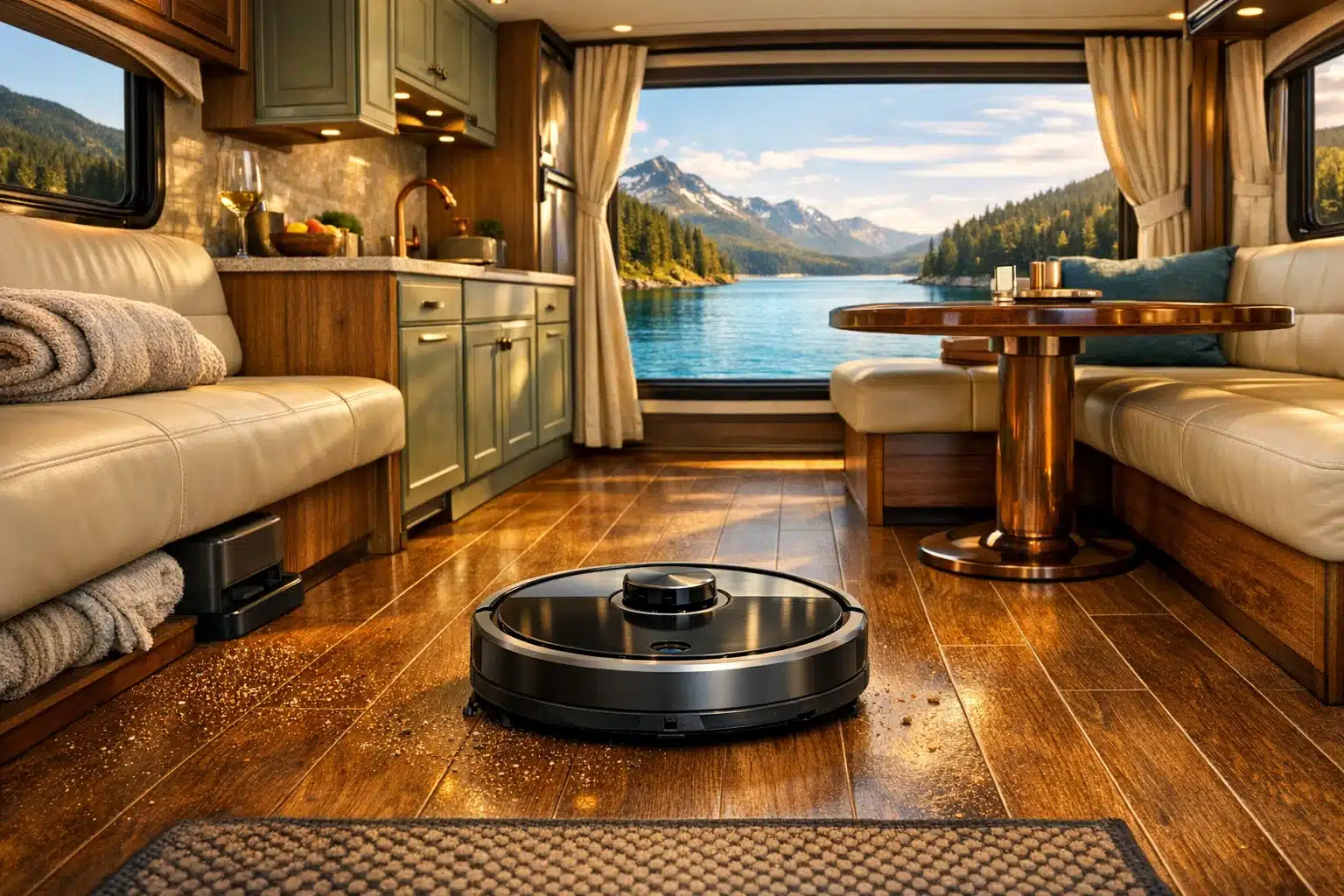
The phrase portable robot vacuum cleaner does not always refer to a formal industry category, yet it is a useful description for a specific type of product. These models are designed to be easier to carry, store, and reposition than larger home-focused units. They often have slimmer profiles, lighter bodies, and smaller charging docks. That makes them attractive for studio apartments, dorm rooms, small offices, vacation homes, RVs, and anyone who values flexibility over maximum floor coverage. If a standard robot vacuum feels like a resident appliance, a portable model feels more like a travel companion for tidy spaces.
Portability usually comes from a mix of reduced dimensions and simplified design. Many compact units are lighter and smaller in diameter, making them easier to lift from room to room or pack away in a closet. Their lower height can also help them slide beneath low furniture where bulkier models struggle. In tight living spaces, that can matter more than headline power figures. A portable robot vacuum may be a smart fit when floor area is limited, furniture is close-set, and the main goal is regular pickup of dust, hair, crumbs, and light debris rather than aggressive deep cleaning.
Of course, small size brings compromises. Portable models often have shorter battery life, smaller dustbins, and less powerful brush systems. On paper, that might mean around 60 to 120 minutes of runtime instead of the longer endurance seen in larger premium models. Dustbin capacity can be more limited too, which matters in pet-heavy homes. Portability also affects navigation. Some compact models use simpler movement systems to keep cost and size down, which is fine for one-room or two-room layouts but less ideal for complex homes. Think of them as specialists rather than universal champions. They can be excellent at frequent surface cleaning in smaller environments, but they are not always the best option for thick carpet, long pet fur, or large multi-room homes.
Still, the appeal is easy to understand. A portable robot vacuum is often less intimidating for first-time buyers, easier to tuck away, and more realistic for people who do not want a large dock dominating the hallway. It can also serve as a second device in a larger household, perhaps dedicated to an upstairs office, a rental property, or an entryway that collects grit from shoes. A useful way to frame the category is this: portable models are not miniature versions of every high-end robot vacuum feature, but they can be efficient, practical, and refreshingly low-drama. Sometimes the right tool is not the most powerful machine in the room; it is the one that quietly fits into the room at all.
4. Standard vs Portable Models: Which One Fits Your Space, Budget, and Routine?
Choosing between a standard robot vacuum cleaner and a portable robot vacuum cleaner is less about chasing the “best” product and more about matching a machine to the daily rhythm of a home. A larger standard model typically offers stronger cleaning power, bigger batteries, more advanced mapping, and larger dust capacity. That makes it well suited to multi-room homes, mixed flooring, pets, and users who want more automation with less supervision. Portable models, by contrast, focus on compactness, easier storage, lighter handling, and suitability for smaller or more mobile living arrangements. Neither approach is inherently superior; each solves a different problem.
Consider a few common scenarios. A family in a two-bedroom apartment with a dog may benefit more from a standard model because pet hair accumulates quickly and floor area is large enough to justify stronger runtime and a bigger bin. A student in a dorm or studio may find a portable model ideal because storage is limited and the cleaning area is small enough that a simpler machine is completely adequate. An RV owner or frequent traveler may value portability above all else, especially if the unit needs to be moved, stored, and redeployed often. A retiree in a compact home may prefer the lighter unit if easy handling matters more than advanced app controls.
Budget also shapes the decision. While prices vary widely, portable and basic robot vacuums often sit in more accessible price ranges, while advanced mapped models with self-empty docks can rise considerably. Cost should be viewed in context. A lower upfront price may be attractive, but if the machine struggles with your actual floors, requires constant rescues, or fills its bin after every run, convenience drops fast. On the other hand, paying for advanced mapping in a single small room may be unnecessary. Some practical comparison points include: • home size and room count • carpet vs hard-floor ratio • pet hair volume • storage availability • willingness to use an app • need for carrying the device between locations.
There is also a subtle lifestyle factor. Standard models suit people who want an appliance that becomes part of the house, always docked and ready. Portable models suit people who want a tool that adapts to change. One behaves like a quiet household staff member with a schedule; the other feels more like a nimble helper you can pick up and redeploy without ceremony. If you know which of those two images fits your life, the decision becomes much easier. The smartest purchase usually comes from honesty: how much floor do you have, what kind of mess appears most often, and how much effort are you trying to remove from your week?
5. Buying Smart, Maintaining Well, and Choosing the Right Robot Vacuum for Your Needs
Once you narrow the field, the final decision should be guided by practicality rather than excitement. Start with flooring. Hard floors and low-pile rugs are generally easy territory for most robot vacuums, while thick carpet, fringe edges, and frequent pet hair demand better brushes and stronger pickup. Next, measure the environment instead of guessing. Check bed and sofa clearance if you want under-furniture cleaning, note where cords tend to sit, and consider whether a large dock will fit naturally into the room. If you are drawn to a portable model, think honestly about how often you will move it and whether that flexibility will actually be used or simply admired.
Maintenance is where long-term satisfaction is won or lost. Even the most advanced robot vacuum still needs human support. Brushes collect hair, filters clog, sensors get dusty, and wheels can trap string. A good maintenance rhythm is simple: empty or check the bin regularly, clean the main brush and side brushes, wipe sensors, and replace consumables when performance drops. Many owners underestimate how much better a robot vacuum works after ten minutes of basic care. If the machine begins missing spots or getting lost, the issue is often not mysterious software failure but ordinary buildup. A little attention keeps performance predictable.
Battery health and software support matter over time too. Rechargeable batteries naturally age, so it helps to buy from a product line with clear replacement parts and ongoing app support. Look for accessible filters, brushes, and rollers rather than obscure components that are hard to source. Privacy-minded users should also review app permissions and cloud features, especially in mapped models. Not every household is comfortable with detailed room mapping stored in an app, and that is a reasonable consideration. A buying checklist can help: • cleanability of brushes • replacement part availability • realistic runtime for your floor area • noise level • navigation quality • storage footprint • total cost over several years, not just purchase price.
For the target audience, the conclusion is straightforward. If you live in a larger home, manage pet hair, or want a machine that handles routine cleaning with minimal intervention, a standard robot vacuum cleaner will usually deliver better value and stronger daily performance. If you need something light, compact, easy to store, and suitable for smaller spaces or mobile living, a portable robot vacuum cleaner can be the more sensible and satisfying choice. The best model is not the one with the longest feature list; it is the one that quietly keeps your floors in shape without becoming another task to manage. When chosen with clear expectations, a robot vacuum does exactly what good home technology should do: it gives time back without asking for much in return.