Guide to Portable Laser Cleaning Machine: Applications, Benefits, and Technology Overview
Portable laser cleaning machines have moved from specialist workshops into mainstream maintenance, manufacturing, and restoration because they remove rust, paint, oxide, and residue with remarkable control and minimal secondary waste. As factories pursue cleaner processes and faster turnaround, these compact systems offer a practical alternative to abrasive blasting, harsh chemicals, and labor-intensive scraping.
Article Outline and Why Portable Laser Cleaning Matters
Before diving into technical detail, it helps to map the road ahead. This article is structured to answer the most common questions buyers, plant managers, maintenance technicians, and restoration professionals ask when they first encounter a portable laser cleaning machine. The topic matters because surface preparation sits at the heart of industrial quality. If rust is left behind, a coating can fail early. If contamination remains on a weld zone, joint quality can suffer. If a cleaning process creates too much dust, waste, or downtime, the hidden costs quickly start to overshadow the original budget. In that context, a portable laser cleaner is not simply a new gadget. It is a different operating model.
A useful way to think about the technology is this: traditional cleaning methods usually rely on contact, abrasion, chemicals, or all three. Laser cleaning relies on controlled energy. Instead of throwing grit at a surface or soaking a part in solvents, the machine directs a focused beam that interacts with contamination more selectively. That change sounds simple, but it affects labor, consumables, cleanup, environmental handling, and even floor layout. Portable systems are especially relevant because they bring this capability to parts that cannot easily be moved to a fixed station.
Here is the outline this guide follows:
– what portable laser cleaning machines are and how they work
– where they are used and what benefits they offer in daily operations
– how smart portable laser cleaning machines differ from standard units
– what limitations, safety requirements, and cost factors buyers should evaluate
– how to choose a system that fits workload, material type, and team skill level
The growing interest in these machines is tied to several practical trends. Manufacturers want repeatable cleaning with less mess. Repair teams want tools they can wheel to the job instead of bringing every part back to a blasting room. Restoration specialists want precision, especially when removing contamination from valuable metal surfaces. In many cases, the appeal lies in reducing consumables and avoiding aggressive methods that may roughen or erode the base material. Still, not every task is ideal for laser cleaning, and that is why a balanced guide matters. The next sections move from basic principles to smart features and real-world decision making, so readers can separate marketing language from workable reality.
How a Portable Laser Cleaning Machine Works
A portable laser cleaning machine uses concentrated light energy to remove surface contaminants such as rust, oxide layers, paint residues, oils, and some coatings. In many industrial systems, the laser source is a fiber laser, often operating around a wavelength of 1064 nm. The beam travels through a delivery cable to a handheld cleaning head, where it is scanned across the target area. The operator controls parameters such as power, frequency, pulse width, scan width, and cleaning pattern. Those settings matter because laser cleaning is not one-size-fits-all. A thin oxide film on stainless steel requires a different energy approach than thick rust on carbon steel.
The cleaning effect is usually based on differences in how contaminants and base materials absorb energy. The unwanted layer heats, fractures, vaporizes, or detaches more readily than the substrate below. In pulsed systems, short bursts of energy can improve selectivity and reduce heat input, which is especially useful when operators want to preserve the underlying surface texture. Continuous-wave systems may be used for other tasks, but pulsed machines are often favored for precision cleaning. That is one reason laser cleaning has attracted attention in restoration and higher-value fabrication work.
A typical portable unit includes several core elements:
– a laser source cabinet
– a handheld scanning head
– a control interface or touchscreen
– cooling components, which may be air-cooled or water-cooled depending on power level
– safety features such as emergency stop controls, key switches, and interlocks
– fume extraction or compatibility with external extraction equipment
Portability does not mean pocket-sized. In practice, many systems are wheeled units designed to move across a workshop floor, load into a service vehicle, or reach field maintenance locations with less hassle than a fully fixed installation. Head weight, cable length, cabinet size, and power supply requirements all influence how portable a machine feels in daily use. This is where brochures can be optimistic and reality becomes more interesting. A machine may technically be mobile, but if the cleaning head is heavy and the cables are stiff, operator fatigue will shape productivity.
Compared with abrasive blasting, laser cleaning usually produces far less consumable waste because there is no media to refill, recover, or dispose of. Compared with chemical stripping, it can reduce liquid waste handling and shorten preparation steps. However, it still requires good process setup. Fume extraction is important, reflective materials need careful adjustment, and operators must understand how beam settings affect both speed and finish. The result is a tool that can be highly precise, but only when used with a clear understanding of material behavior and process control.
Applications, Benefits, and Real-World Trade-Offs
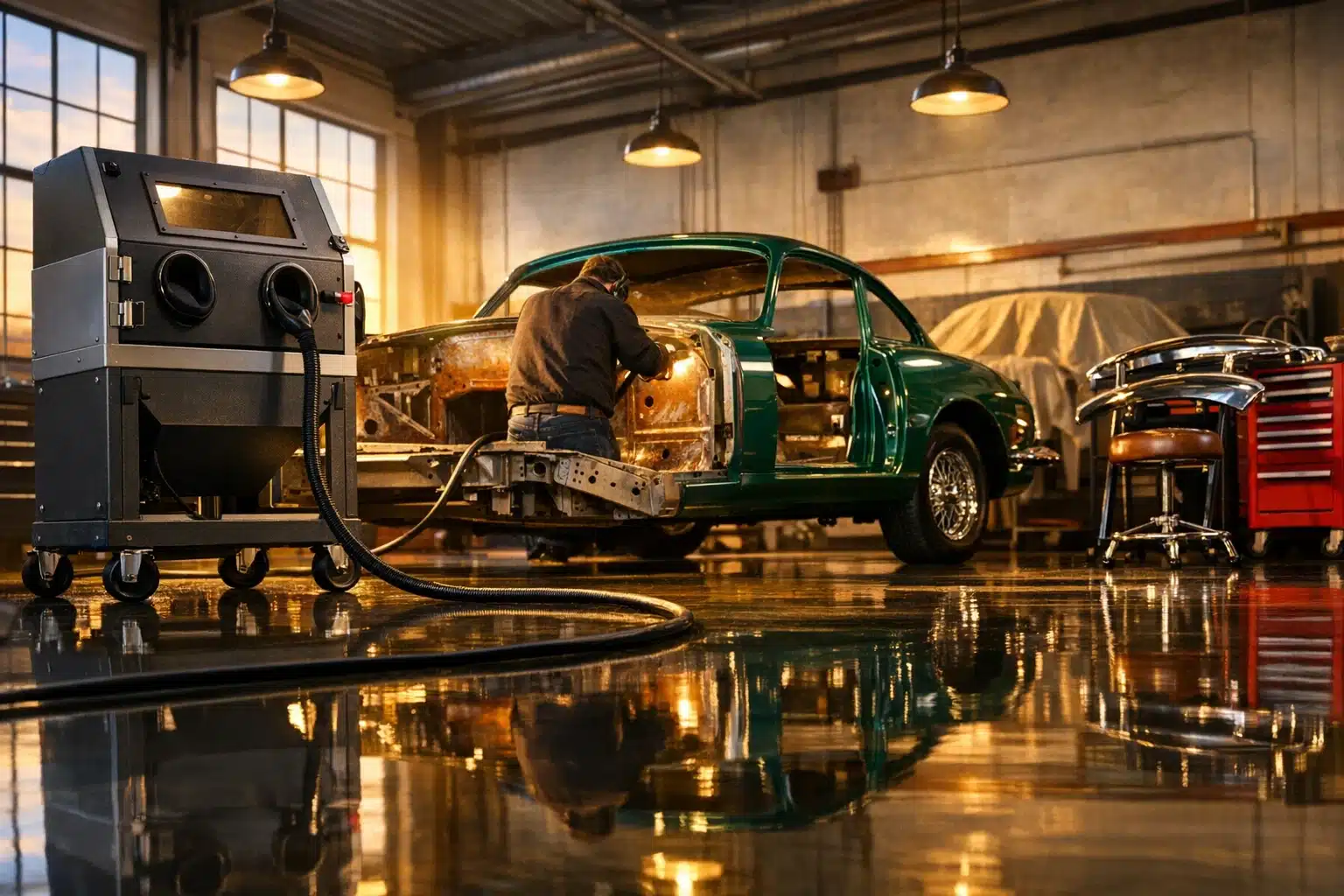
Portable laser cleaning machines are now used across a wide spread of industries because contamination rarely appears in just one form. In metal fabrication, they are used for pre-weld cleaning, post-weld discoloration removal, and surface preparation before coating or bonding. In automotive restoration, they can help remove rust from panels, frames, brackets, and hard-to-reach components without blasting media into every seam. In manufacturing maintenance, they are used to clean molds, tools, fixtures, and machine parts where precision matters more than raw stripping speed. Ship repair, rail maintenance, aerospace support operations, and heritage restoration have also shown interest, especially where localized cleaning is more practical than moving large parts to centralized treatment areas.
The benefits are appealing, but they are best understood in operational terms rather than slogans. A portable laser cleaner may reduce cleanup time because there is no sand, glass bead, or dry chemical residue to collect from the work area. It can also improve selectivity, which matters when the goal is to remove a contaminant while preserving the underlying geometry. That is particularly helpful on edges, engraved surfaces, or complex assemblies where aggressive abrasion can remove more than intended. Many users also value the reduced need for consumables, since recurring purchases of blast media or chemicals can become a meaningful line item over time.
Some practical advantages often cited by operators include:
– cleaner work areas with less secondary waste
– easier spot treatment on large or installed components
– reduced surface roughening compared with more aggressive abrasive methods
– better control on delicate or high-value parts
– less dependence on chemical storage and disposal procedures
Still, a realistic assessment requires trade-offs. Laser cleaning is not automatically faster in every case. Thick multilayer coatings over large surfaces may still be more economical with other methods, especially when finish quality is less critical. Very large production volumes may favor automated or fixed laser cells rather than portable units. Reflective metals can demand careful parameter tuning. Fume extraction is not optional, because the removed material does not simply vanish into good intentions; it becomes airborne particulates or vapor that must be managed properly. Initial purchase cost is also higher than many entry-level blasting tools, which means return on investment depends on workload, labor savings, rework reduction, and consumable savings.
This is why comparisons should be task-specific. If a workshop regularly cleans localized rust, weld zones, molds, or precision parts, a portable laser cleaner can be a strong fit. If the job mainly involves stripping broad, heavily coated surfaces at the lowest immediate cost, a different process may still win. The strongest case for laser cleaning usually appears where control, cleanliness, reduced waste, and repeatability matter enough to justify the capital investment. In other words, the machine shines brightest when the work itself rewards precision.
What Makes a Smart Portable Laser Cleaning Machine Different
A smart portable laser cleaning machine takes the core laser process and adds digital control layers that make operation more consistent, easier to document, and sometimes easier to scale across multiple operators or sites. The phrase smart should be used carefully, because it can mean anything from a polished touchscreen to a genuinely connected system with sensors, data logging, recipe management, and remote diagnostics. At its best, a smart model does not change the physics of cleaning; it changes how reliably those physics are applied.
One of the most useful smart features is recipe-based operation. Instead of asking every operator to build settings from scratch, the machine can store presets for specific materials and tasks. For example, a shop may save one recipe for rust removal on structural steel, another for weld cleaning on stainless parts, and another for paint removal from tooling. That reduces setup time and makes results more repeatable across shifts. It also lowers the learning curve for newer operators. In busy environments, repeatability is not a luxury. It is what keeps rework from quietly eating margins.
Smart portable systems may also include:
– touch interfaces with guided setup steps
– user access levels for supervisors and operators
– cleaning process logs for quality documentation
– sensor feedback related to temperature, operating status, or head movement
– maintenance alerts and fault diagnostics
– network connectivity for software updates or remote support
Some higher-end systems push further with adaptive features. These may include monitoring that helps the machine maintain more stable output or warns the operator when settings drift outside recommended ranges. In a production environment, even simple data logging can be valuable. If a customer asks how a part was processed, the team may be able to review the selected program, run time, and machine status rather than relying on memory. That is especially relevant in sectors where documentation matters, such as aerospace support, medical manufacturing, or high-spec fabrication.
The contrast between a standard and a smart portable laser cleaner is similar to the difference between a hand tool and a hand tool with a built-in job memory. Both can perform the task, but the smarter one helps preserve good practice. It may also improve uptime by identifying issues early, such as cooling faults or service intervals. For multi-site companies, fleet visibility can be a major advantage. Managers can see which machines are being used, how often, and whether training gaps are causing process inconsistency.
That said, smart features should support the job rather than distract from it. A crowded interface, weak software support, or unreliable connectivity can create frustration instead of value. Buyers should ask whether the digital layer improves safety, traceability, and efficiency in their real workflow. When the answer is yes, a smart portable machine becomes more than a cleaner. It becomes a process management tool with a beam at the end of the cable.
Choosing the Right System, Operating Safely, and Final Takeaways for Buyers
Selecting a portable laser cleaning machine starts with a simple question that deserves an honest answer: what exactly are you cleaning, how often, and to what finish standard? Buyers often focus first on wattage, but power is only part of the picture. A 50 W or 100 W pulsed unit may be enough for light rust, oxide removal, detail work, and maintenance tasks. A 200 W or 300 W class system may be more suitable for heavier contamination or faster throughput. Yet if the machine is powerful but awkward to handle, poorly supported, or difficult to program, daily use may never match the promise on the spec sheet.
Key evaluation points should include:
– material types and contamination thickness
– expected cleaning speed and duty cycle
– pulse characteristics and parameter range
– cleaning head weight and ergonomics
– cable length and mobility around the work area
– cooling method and power supply requirements
– software quality, recipe storage, and user permissions
– local service access, training availability, and spare parts support
Safety deserves equal attention. Industrial laser systems can pose serious eye and skin hazards if they are used improperly. Buyers should plan for correct protective eyewear matched to the machine, defined work zones, warning signage, emergency stops, and proper operator training. Fume extraction is essential because the process lifts contaminants from the surface and can release hazardous particles depending on what is being removed. Coatings, oils, and corrosion products should be treated with care, and local workplace regulations should guide extraction, filtration, and ventilation practices. A clean process is not the same thing as a risk-free process.
Ownership costs should be considered over the full lifecycle rather than at purchase alone. Laser cleaning can lower spending on consumables and reduce cleanup labor, but buyers should also account for training time, service intervals, optics care, downtime risk, and any required extraction equipment. The best purchasing decisions usually come from a trial on real parts, not from generic demonstrations on ideal test coupons. If a vendor can show performance on your actual rust, your actual coating, and your actual productivity target, the conversation becomes far more useful.
For workshop owners, maintenance teams, restoration specialists, and manufacturing engineers, the practical takeaway is clear. A portable laser cleaning machine can be an excellent tool when precision, lower secondary waste, and flexible deployment matter more than brute-force stripping. A smart portable laser cleaning machine adds another layer of value when repeatability, documentation, and easier operation are important to the business. The right machine is not the one with the loudest marketing language. It is the one that fits your materials, your team, your safety framework, and the kind of work waiting on the bench tomorrow morning.